
Texas County Court Records After Arrest
After a Texas County arrest, the jail records booking and custody information while the prosecutor decides whether formal charges should be filed. The Texas County District Attorney page identifies the office as the District One prosecutor for Texas, Cimarron, Beaver, and Harper Counties. George H. Leach III is listed as district attorney, with Peggy L. Pack, Taos C. Smith, Parker Olmstead, and Ryan D. Reddick listed in assistant or first-assistant roles. Their filed charges become the court record for a criminal case.
The Texas County Court Clerk is the local office for filed court records. The county court clerk page names M. Renee Ellis as court clerk and says the office files and preserves District Court proceedings, maintains appearance dockets, keeps filed transcripts, collects fees, and works with criminal, civil, probate, juvenile, domestic, and small-claims divisions. Current custody belongs with Texas County jail inmate records; booking photos belong with the separate jail mugshot request process.
Find Texas County Court Records After Arrest
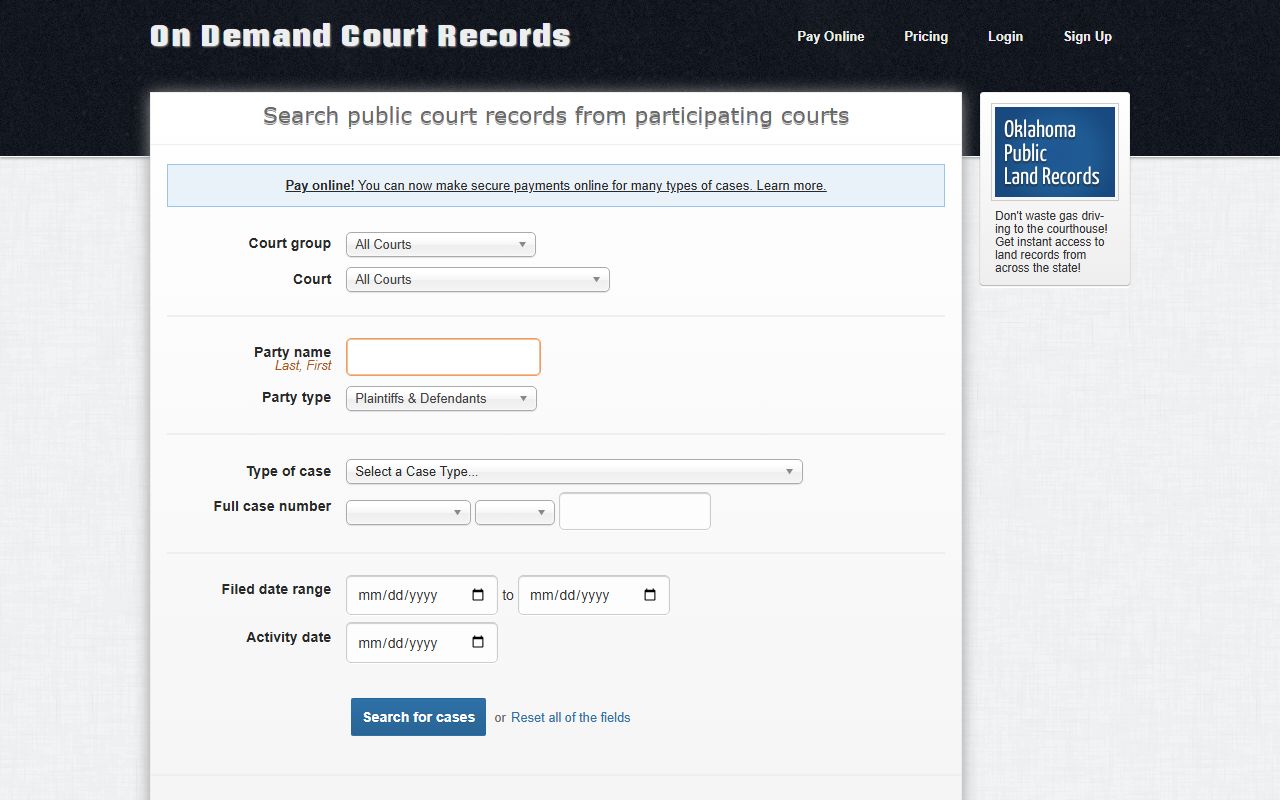
ODCR is the first local court-search route because the official Texas County Court Clerk page links to it as "Search Court Records." ODCR includes Texas County as a court option and provides criminal case-type filters. OSCN is a second official statewide docket path with Texas County District Court, case number, party-name, birth-date, party-role, case-type, filed-date, closed-date, lower-court, and citation-search fields. Browser access to OSCN can show a verification screen, so try again from a normal browser if a search stalls.
- Open ODCR and set the court to Texas for local District Court matters.
- Search by party name in "Last, First" format, or use a full case number if known.
- Limit case type to criminal felony, criminal misdemeanor, criminal probable cause, or criminal proceedings not filed when the arrest is recent.
- Open the case record and compare filed charges, bond events, warrants, hearings, and dispositions with the booking facts.
- Repeat the search in OSCN docket search if ODCR does not show the case or if a statewide search is needed.
The ODCR search home shows the Texas County court dropdown and criminal case-type fields used for post-arrest court records.
The court search is useful after filing, but it should not be treated as proof that a person is still housed in Texas County Jail.
Texas County ODCR and OSCN Fields
Use ODCR when the court clerk's local link is the best path. Use OSCN as a second official search, especially when the case number is known or a statewide party search is needed. Both systems are court-record tools. They are not jail rosters, booking-photo galleries, or current custody logs.
| System | Field | Use for Texas County Court Records |
|---|---|---|
| ODCR | Court | Choose Texas for Texas County District Court cases. |
| ODCR | Party name | Search as "Last, First" when no case number is known. |
| ODCR | Type of case | Use criminal felony, criminal misdemeanor, criminal probable cause, criminal proceedings not filed, search warrants, traffic, or youthful offender as the facts require. |
| ODCR | Full case number | Use prefixes such as CF, CM, CP, SW, or TR with year and number when known. |
| OSCN | County or Court | Choose Texas County District Court. |
| OSCN | Last, first, and middle name | Search by defendant name, with birth-date filters when needed. |
| OSCN | Party type | Filter to defendant, district attorney, arresting agency, arresting officer, bail bondsman, surety depositor, witness, or all parties. |
| OSCN | Limit by case type | Use criminal felony, criminal misdemeanor, criminal probable cause, search warrant, traffic, writ, or youthful offender. |
Texas County Arrest to Court Path
The post-arrest path is not one record. It is a sequence. A deputy, police officer, trooper, or other officer arrests the person. Jail staff under the Texas County Sheriff's Office, led by Sheriff Matt Boley in the official county listing, book the person at Texas County Jail when it is an adult local matter. A first appearance or bond event may occur. The District Attorney reviews reports and decides whether to file, decline, amend, reduce, or add charges. When the case is filed and indexed, ODCR or OSCN can show the court record.
The docket may show a case number, parties, charge type, filings, hearing dates, bond entries, warrants, dispositions, payments, and some court costs. It may not show the booking photo or live cell location. A dismissal, reduction, or amended charge does not automatically erase the original jail booking record, which is why court records after a jail arrest must be read with the jail record in mind.
Arrest > booking > first appearance > prosecutor filing > docket entry > hearings > disposition is the practical flow.
Texas County Charging Documents
The charging document is the paper that starts or frames the court case. Oklahoma criminal cases commonly use prosecutor-filed complaints or informations. An indictment comes from a grand jury and is less common in routine county cases. The important point is simple: jail booking language can differ from the filed court charge.
| Document | Who Files It | What It Means |
|---|---|---|
| Complaint | Officer or prosecutor, depending on case path | Begins a criminal matter or supports probable cause for the alleged offense. |
| Information | District Attorney | Formal prosecutor-filed charge document used in many felony and misdemeanor prosecutions. |
| Indictment | Grand jury | Formal charge returned by a grand jury, used less often than an information in routine local cases. |
Texas County Charge Status
Charge status is where readers often make mistakes. A booking charge is an arrest-side label. A filed charge is the prosecutor's court-side accusation. A conviction is the result after a plea, verdict, or other final adjudication. Texas County court records after a jail arrest can show changes over time, including reduced counts, amended counts, dismissals, warrants, or final sentence entries.
| Status | Meaning in a Court Record |
|---|---|
| Pending | The charge is active and has not reached final disposition. |
| Amended | The prosecutor or court record changed the charge, count, wording, or level. |
| Reduced | The charge moved to a lesser offense or lower severity than the original filing. |
| Dismissed | The charge was dropped by court order or prosecutor action, but related booking records may still exist unless sealed or expunged. |
| Declined or not filed | The prosecutor did not file a formal case from the arrest-side information available. |
| Convicted | The case resulted in a guilty plea, verdict, or other conviction entry. |
Texas County Bond Records After Arrest
No Texas County-specific bond instruction page was found. The practical route is to confirm custody and release conditions with the sheriff's office at 580-338-4000, then check ODCR or OSCN for filed case entries, bond amounts, bond changes, and court orders. The court clerk can route court-cost or payment questions, but the jail must confirm whether a posted bond will actually release the person.
| Bond Type | How It Works | Texas County Note |
|---|---|---|
| Cash bond | The full amount is paid as security for appearance. | Payment method and after-hours rules were not published; call first. |
| Surety bond | A licensed bondsman posts bond and assumes risk for a fee. | Confirm the jail will accept the bond for that case. |
| Personal recognizance | Release is based on a promise to appear, with conditions if ordered. | Set by court or judge, not by a roster. |
| No-bond or hold | Ordinary bond will not release the person until the hold clears. | Can stem from warrants, DOC, federal, ICE, or another county. |
Texas County Warrants and Arrest Records
The sheriff page says the Texas County sheriff serves warrants and court papers ordered by the District Court, but no official online active warrant search or most-wanted list was found on the county or sheriff site. Use official channels, not unofficial warrant pages. Call the sheriff at 580-338-4000, search ODCR and OSCN for bench warrants, failure-to-appear events, search warrants, and criminal case entries, and contact the relevant municipal court for city-level matters when the issue is a Guymon or other municipal case.
A warrant can lead to booking at Texas County Jail. Bond may be preset, set later by a judge, or unavailable until the person appears in court. A warrant or detainer from another county, state, federal court, DOC, parole authority, or ICE can keep a person in custody even when a Texas County case appears bondable.
Charges vs Convictions
A charge is an accusation. A conviction is a result. Texas County court records after a jail arrest should not be read as proof of guilt just because a case exists. The docket must be checked for final disposition, sentence, dismissal, deferred outcome, or continuing status.
| Issue | Charge | Conviction |
|---|---|---|
| Stage | Filed accusation by the state | Result after plea, verdict, or judgment |
| Proof level | Based on probable cause and prosecutor review | Based on plea or proof beyond a reasonable doubt |
| Record meaning | Shows what the person is accused of | Shows the resolved offense and judgment |
| Custody effect | May affect bond and pretrial release | May lead to sentence, probation, jail, or ODOC transfer |
Sealed vs Expunged Texas County Records
Oklahoma open-records access has limits. Juvenile matters, sealed cases, expunged records, medical or mental-health details, protected victim information, ongoing investigative material, and certain witness information can be withheld or redacted. OSBI states that expungement eligibility categories are found in 22 O.S. Section 18(A) and that OSBI cannot pre-approve a person for expungement.
| Issue | Sealed | Expunged |
|---|---|---|
| Public visibility | Hidden or restricted from normal public access. | Removed from public view under the court order and applicable law. |
| How it happens | Usually by court order or statutory confidentiality. | Requires eligibility and a formal expungement process. |
| Booking effect | May limit release of related records. | Can support requests to update or restrict records held by agencies. |
| Practical step | Ask the clerk what order controls access. | Use OSBI/court procedures or counsel for eligibility and filings. |
Important: A dismissed charge does not automatically erase a booking record; sealing or expungement requires the proper legal process.
Texas County Court Offices
The Texas County Court Clerk is listed at P.O. Box 1081, 319 N. Main St., Ste. 301, Guymon, OK 73942, with phone 580-338-3003. The District Attorney is listed at 319 N. Main, Guymon, OK 73942, with phone 580-338-3388, fax 580-338-0528, and hours 8:30 a.m. to 5:00 p.m., closed 12:00 to 1:00. Use the clerk for filed court records and certified copies. Use the DA context to understand who reviews reports and files formal charges.
For booking photos or jail-register records tied to the same arrest, use the sheriff's open-records route or the Texas County jail mugshots request process.